Peptides are the ABCs of life.
Every peptide is a short sentence written in an alphabet of just 20 amino-acid letters, linked head-to-tail by peptide bonds. Nature has written millions of these molecules — hormones, venoms, antibiotics, neurotransmitters — and only a small fraction have ever been isolated, sequenced, or studied. This explorer is a field guide to the ones we know best.
A simple alphabet, endless words
A peptide is nothing more — and nothing less — than a chain of amino acids, each link chosen from 20 standard residues. With 20 choices at every position, a chain of length n has 20ⁿ possible spellings, from 400 dipeptides to more 60-mers than atoms in the universe.
Millions written, few read
Every species samples this space: signaling peptides in your brain, defense toxins in snail and snake venom, antimicrobials on frog skin. Millions of distinct sequences exist — a few thousand are characterized, and only a few dozen have become medicines.
Beyond the 20 letters
Real peptides are often edited after translation — or engineered in the lab: disulfide staples, C-terminal amides, D-amino acids, sugar decorations (glycosylation), spacer and linker molecules, and cargo adducts such as fatty-acid tails, PEG, and metal chelators that tune half-life and targeting. See the Adducts column below.
The alphabet — IUPAC codes for the 20 canonical amino acids
Every sequence in the database below is spelled with these one-letter codes. The three-letter codes appear in structural formulas and older literature. Click the chart for a full-size view.
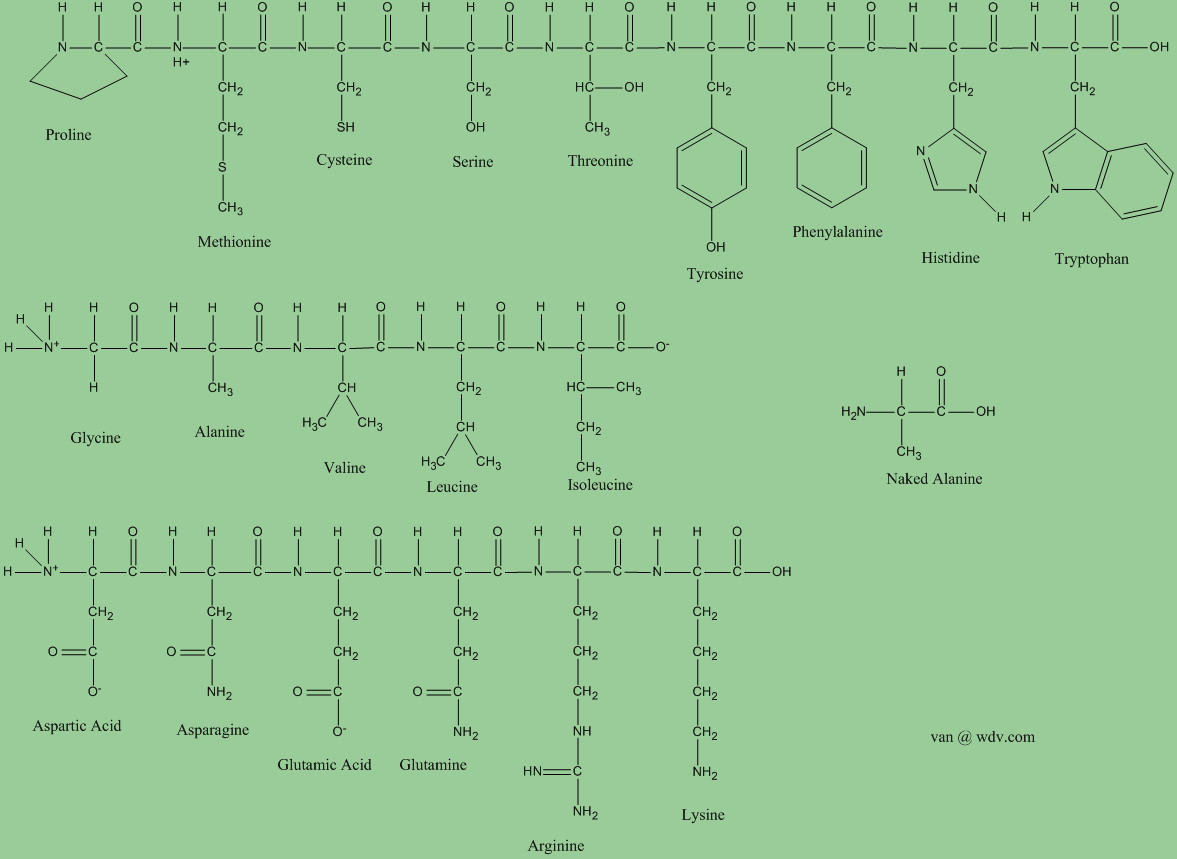
| Amino acid | 3-letter | 1-letter | Side chain | Amino acid | 3-letter | 1-letter | Side chain |
|---|---|---|---|---|---|---|---|
| Alanine | Ala | A | nonpolar | Arginine | Arg | R | basic (+) |
| Asparagine | Asn | N | polar amide | Aspartic acid | Asp | D | acidic (−) |
| Cysteine | Cys | C | thiol (S–S bonds) | Glutamic acid | Glu | E | acidic (−) |
| Glutamine | Gln | Q | polar amide | Glycine | Gly | G | smallest (H) |
| Histidine | His | H | basic (+) | Isoleucine | Ile | I | nonpolar |
| Leucine | Leu | L | nonpolar | Lysine | Lys | K | basic (+) |
| Methionine | Met | M | sulfur, start codon | Phenylalanine | Phe | F | aromatic |
| Proline | Pro | P | imino (ring) | Serine | Ser | S | polar (OH) |
| Threonine | Thr | T | polar (OH) | Tryptophan | Trp | W | aromatic |
| Tyrosine | Tyr | Y | aromatic (OH) | Valine | Val | V | nonpolar |
Mnemonics for the tricky one-letter codes: N = asparagine, D = aspartic "D", Q = "Q-tamine" (glutamine), E = E-glutamate, R = aRginine, K = lysine ("K" is before L), F = Fenylalanine, W = tryptophan (double-ring, "double-u"), Y = tYrosine (T was taken).
The combinatorial bracket — 20ⁿ sequence space
Why so much of peptide space remains unexplored: the library grows 20-fold with every residue added.
| Length n | Possible sequences (20ⁿ) | Family / Example | Scale Comparison |
|---|---|---|---|
| 2 | 400 | Dipeptides — Carnosine | — |
| 3 | 8,000 | Glutathione, TRH, KPV | — |
| 4 | 1.6 × 10⁵ | Epitalon | — |
| 5 | 3.2 × 10⁶ | Enkephalins, Ipamorelin | — |
| 7–9 | 1.3 × 10⁹ – 5.1 × 10¹¹ | Semax, Selank, Oxytocin, α-Amanitin | ~ World human population at n = 9 |
| 10 | 1.0 × 10¹³ | GnRH (Gonadorelin) | — |
| 15–16 | 3.3 × 10¹⁹ – 6.6 × 10²⁰ | BPC-157, MOTS-c | — |
| 20 | 1.05 × 10²⁶ | Bivalirudin, Peginesatide (monomer) | Avogadro's Number (~6.022 × 10²³) |
| 29–31 | ~10³⁷ – 10⁴⁰ | Glucagon, GLP-1 analogs (Semaglutide) | Approaching Shannon number for chess positions (~10⁴⁴) |
| 39 | 5.5 × 10⁵⁰ | Exenatide, Tirzepatide | Exceeds all possible chess positions |
| 51 | 2.3 × 10⁶⁷ | Insulin (A + B chains combined) | — |
| 60 | 1.15 × 10⁷⁸ | Dendrotoxin-K | Approaching total atoms in observable universe (~10⁸⁰) |
| 68–100 | ~10⁸⁸ – 1.3 × 10¹³⁰ | Chemokines (CXCL8, CCL2, CXCL12) | Passes Shannon number for unique chess games (~10¹²⁰) |
| 110–200 | 1.3 × 10¹⁴³ – 1.6 × 10²⁶⁰ | Cytokines & Growth Factors (EPO, G-CSF) | Far beyond physical enumeration |
Database explorer
Reads peptides.csv from the same folder automatically — nothing to configure.
Tips: click a column header to sort · click a name for the detail panel · click a sequence to copy it ·
press / to search · drop peptides.csv anywhere on the page to load it ·
everything you do is encoded in the URL, ready to share
Couldn't reach peptides.csv automatically
Browsers block direct file access when this page is opened by double-clicking (file://).
Either drop the file here, or serve the folder and reload:
| Peptide | Family | Len (aa) | Sequence / Structural Composition | Non-Peptide Adducts / Spacers | Mechanism of Action & Target | Typical Regimen | Cost ($/mg) | Status | Rating |
|---|